THE MOUNTAIN IS CALLING, NOW I MUST GO


My mother reveres Mount Iwaki. Situated to the south-west of her village, Kase, she had always had a clear view to volcanic cone-shaped presence of the mountain when she lived in Aomori in her early years. But she is not the only one revering the magnetic presence of the Mountain. Most people who feel the mountain, have a sense of awe, respect and connection to Iwakisan (岩木山).
When I rented a car for a couple of days to explore Aomori with my mother, her immediate response to my question, 'where shall we go?' was 'Iwakisan.'
Of course, no doubt, Mt. Iwaki is the first place we will go to as humble pilgrims.
A dear friend appeared on our journey as our guardian angel while we stayed in my mother's ancestral home, in Kase. Shoko san is an elegant guide, with deep pockets of knowledge transmuted to wisdom. Her late husband was a keen mountain climber and skier. Had he seen our preparation to climb Mount Iwaki, he would have told us right away that we'd better wear proper mountain climbing shoes. As it turned out we only had one pair of mountain-climbing boots between us.
We set out early from home, with a sense of reverence because we were going to the Sacred Mountain. This was my first day of driving in Japan. I drive all the time in Scotland where I live. Fortunately in Japan, the driver side is on the right, the same as Scotland. This makes it slightly easier to sit on the driver's seat. But the behavior of Japanese drivers are different than those of the Scotts. I studied what I could about how to drive in Japan, and trusting the roads, we were on our way to the Mountain.
What a journey this was! Like any worthwhile experience, the essence of the journey is in preparation. Our preparation to approach the Sacred Mountain came through delightful stories my mother told me of how she used to go on pilgrimage to Mt. Iwaki with her grandmother and their folks as a ten-year-old. 'Back then' she told me 'going to Mt. Iwaki was a deed, we prepared for it months in advance. We walked and walked to check our footwear. We prepared food. We wore white clothes to become pilgrims. Then only then, after so much preparation of the body and the heart, we started walking.' This was 70 years ago in Aomori. People used horses for long distance travel.
Her words and stories brought us to the present moment. Connecting with our ancestors, recalling how she used to climb Mt. Iwaki in the company of her grandmother and her folks, wearing while pilgrims robes felt so significant. Our drive to Mt. Iwaki now was 'taking the next step' on her path. It felt significant, sacred, summoned. Like the Mountains were calling us, now we must go.
We reached the gate and were given some brochures about how to be in the mountain. I don't read Japanese easily, so I have a bad habit of skimming over papers, my ignorance of the written words quivers a little inside me, and I move on. So I did not register that there was a deadline to leave the car park at the top station by 5.00 pm. We started the steep zig-zag ascent, snaking up the mountain in our rented car.
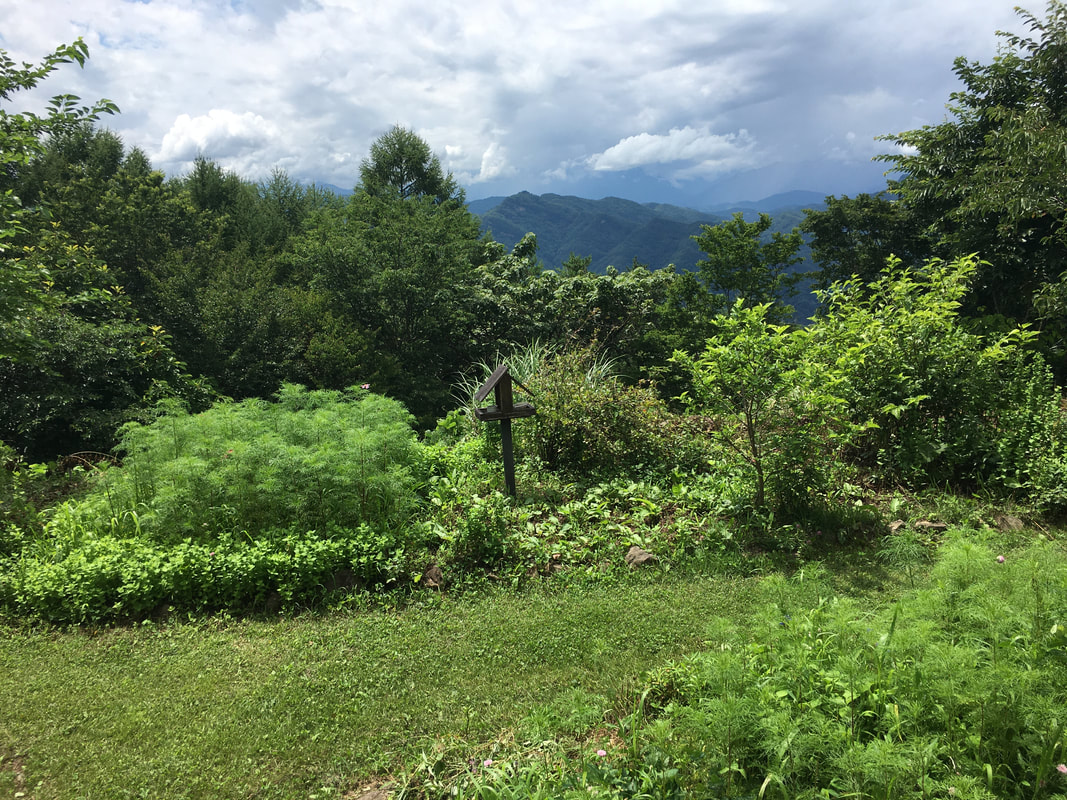
We reached the car park, at last. The clouds were below us at the top car park. We only had one station to climb, to reach the summit ... well one station of the summit, because the mountain goes on and on. So climb, we did. One step at a time, one foot in front of the other. My mother has just become 80 a few weeks before. For an 80 year old, she is agile, in good spirit and physical shape. But the climb was both a test and a testimony of her love for the mountain. And climb she did.
There was a feeling in our hearts that this is her last climb. It turned out to be true, for the following year she fell down while we were in Daisetsuzan National Park and broke both bones in her forearm. Since then the decline in her health accelerated. But that is another story.
Sometimes, when the mountains call, you just got to go. This was that moment. She climbed Iwakisan, after 70 years. She paid her homage. She was home.
When I rented a car for a couple of days to explore Aomori with my mother, her immediate response to my question, 'where shall we go?' was 'Iwakisan.'
Of course, no doubt, Mt. Iwaki is the first place we will go to as humble pilgrims.
A dear friend appeared on our journey as our guardian angel while we stayed in my mother's ancestral home, in Kase. Shoko san is an elegant guide, with deep pockets of knowledge transmuted to wisdom. Her late husband was a keen mountain climber and skier. Had he seen our preparation to climb Mount Iwaki, he would have told us right away that we'd better wear proper mountain climbing shoes. As it turned out we only had one pair of mountain-climbing boots between us.
We set out early from home, with a sense of reverence because we were going to the Sacred Mountain. This was my first day of driving in Japan. I drive all the time in Scotland where I live. Fortunately in Japan, the driver side is on the right, the same as Scotland. This makes it slightly easier to sit on the driver's seat. But the behavior of Japanese drivers are different than those of the Scotts. I studied what I could about how to drive in Japan, and trusting the roads, we were on our way to the Mountain.
What a journey this was! Like any worthwhile experience, the essence of the journey is in preparation. Our preparation to approach the Sacred Mountain came through delightful stories my mother told me of how she used to go on pilgrimage to Mt. Iwaki with her grandmother and their folks as a ten-year-old. 'Back then' she told me 'going to Mt. Iwaki was a deed, we prepared for it months in advance. We walked and walked to check our footwear. We prepared food. We wore white clothes to become pilgrims. Then only then, after so much preparation of the body and the heart, we started walking.' This was 70 years ago in Aomori. People used horses for long distance travel.
Her words and stories brought us to the present moment. Connecting with our ancestors, recalling how she used to climb Mt. Iwaki in the company of her grandmother and her folks, wearing while pilgrims robes felt so significant. Our drive to Mt. Iwaki now was 'taking the next step' on her path. It felt significant, sacred, summoned. Like the Mountains were calling us, now we must go.
We reached the gate and were given some brochures about how to be in the mountain. I don't read Japanese easily, so I have a bad habit of skimming over papers, my ignorance of the written words quivers a little inside me, and I move on. So I did not register that there was a deadline to leave the car park at the top station by 5.00 pm. We started the steep zig-zag ascent, snaking up the mountain in our rented car.
We reached the car park, at last. The clouds were below us at the top car park. We only had one station to climb, to reach the summit ... well one station of the summit, because the mountain goes on and on. So climb, we did. One step at a time, one foot in front of the other. My mother has just become 80 a few weeks before. For an 80 year old, she is agile, in good spirit and physical shape. But the climb was both a test and a testimony of her love for the mountain. And climb she did.
There was a feeling in our hearts that this is her last climb. It turned out to be true, for the following year she fell down while we were in Daisetsuzan National Park and broke both bones in her forearm. Since then the decline in her health accelerated. But that is another story.
Sometimes, when the mountains call, you just got to go. This was that moment. She climbed Iwakisan, after 70 years. She paid her homage. She was home.
 RSS Feed